Range Repair
How to Clean a Wolf Stove Top: Stainless, Grates and Burners
To clean a Wolf stainless stove top, let it cool, lift off the grates and burner caps, then wipe the steel along the grain with warm soapy water on a microfiber cloth, rinse with a damp cloth and dry it at once. Skip steel wool, bleach and oven cleaner.
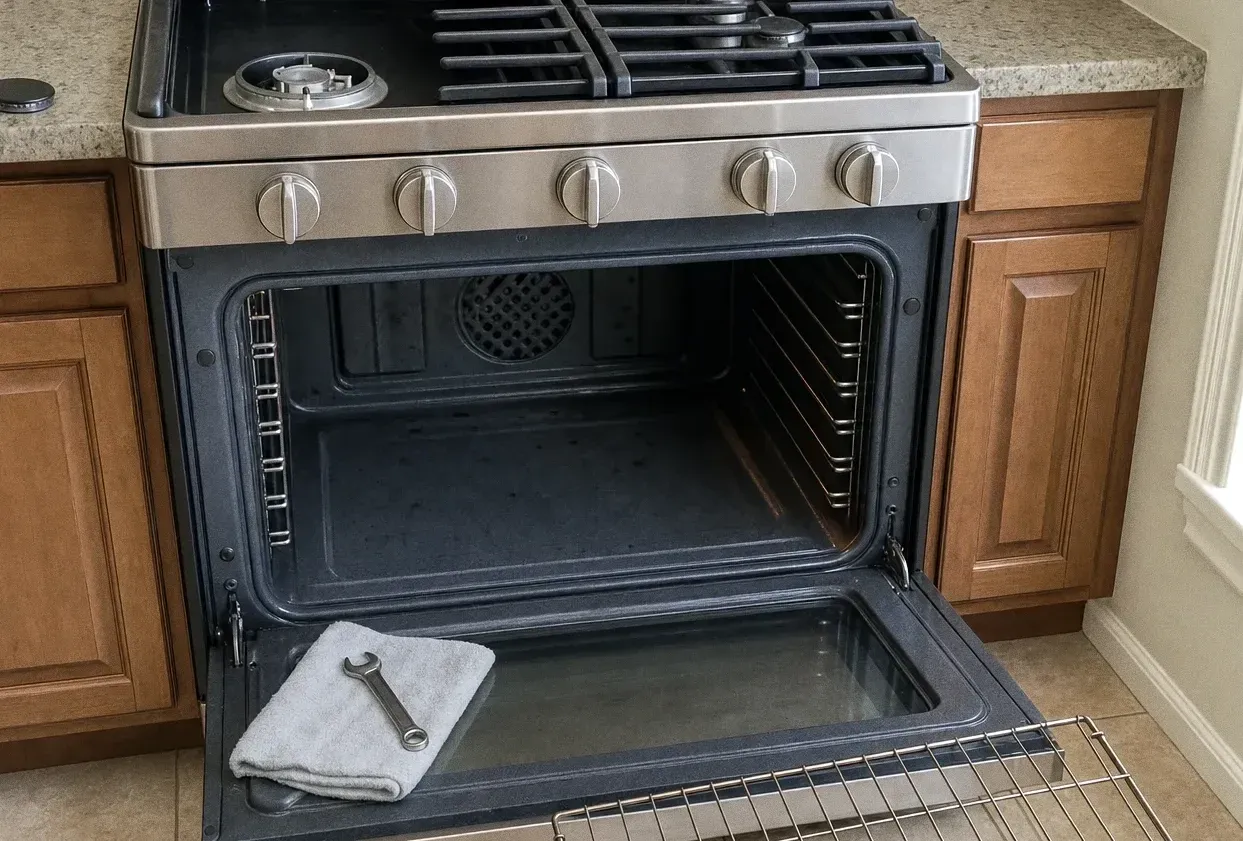
Wait until the burners and grates are cool to the touch, lift the grates and burner caps off, and wipe the stainless using a microfiber cloth wrung out in warm, lightly soapy water, always stroking in the direction of the polish lines. Go over it again with a cloth dampened in plain water, then dry it at once so tap-water minerals do not leave rings. That takes about ten minutes and is worth doing after any messy meal.
A Wolf rangetop is a lot of exposed steel around high-output burners. Grease left to bake on darkens, hardens and eventually works into burner ports and igniters, which is where a cleaning chore turns into a service call. The routine below covers each part and how often it needs attention.
The everyday wipe-down, done properly
Microfiber lifts grease rather than smearing it, and it will not scratch. Paper towels shed lint, and a sponge with a green scrubbing side leaves fine scratches that show under kitchen lighting. The steel has faint lines running in one direction; wipe along them, never in circles, so any tiny marks blend into the finish.
For greasy film on the backguard and front rail, use a little more soap or a degreaser, sprayed onto the cloth first. Liquid sprayed straight onto the top runs under the burner bowls and around the knob stems, where it is hard to rinse away. A stainless polish applied sparingly with the grain hides fingerprints for a few days; a heavy coat attracts dust and can smoke when a burner next runs on high.
If your range has a dual fuel control panel, Wolf’s instructions are to touch and hold Lock for 3 seconds before you wipe it, so a stray swipe cannot start the oven, and to put the degreaser on your cloth rather than on the panel itself.
Grates, burner caps and control knobs
Grates hold most of the burned-on mess and are heavy enough to chip the steel if one slips, so lift them with two hands. Wolf’s guidance for its gas cooktops is hot water with a mild detergent, or a baking soda paste for crusted spots, scrubbed with a non-metal brush at the sink rather than left soaking underwater. Dry them completely before they go back.
Burner caps lift straight off. Wash and dry them the same way, then seat each one flat and centered on its burner head. A slightly crooked cap is a common reason for an uneven flame, a burner that catches on one side only, or an igniter that keeps clicking.
Control knobs pull off their stems. Wipe them with a damp, soapy cloth and dry them; they never go in the dishwasher, where heat and harsh detergent can fade the markings. Wipe around each stem opening with a barely damp cloth, never a wet one.
Burner ports and igniters
With a cap removed, the small slots around the burner head are the ports, and a boil-over fills them with starch, sugar or grease. A blocked port shows as a gap in the ring of flame or a lazy yellow flame on one side. Clear it with a straightened paper clip or a thin sewing needle, pushing straight in and out. Avoid toothpicks, because the tip snaps off inside the port.
The igniter is the small white ceramic post beside each burner. If it is visibly dirty, Wolf says a soft toothbrush can clean it gently; never scrape it with metal. If the ceramic has a crack, has snapped, or wobbles where it is fixed, no brushing will help; that post has to be replaced.
Expect some clicking right after a thorough clean, since moisture keeps the spark system firing until the burner dries. If it carries on into the next day, or a burner is slow to catch, our guide to delayed lighting on a Wolf burner explains what each pattern usually points to.
Stubborn marks and what to leave in the cupboard
Baked-on spots the soapy wipe misses usually come up with a baking soda paste. Spread it on, give it ten minutes to soften the residue, then work it gently with the grain. Rinse twice, because dried baking soda leaves a white haze that looks like a new stain.
A golden or bluish tint on the steel beside the burners is heat discoloration, not dirt. A cream cleaner made for stainless, worked lightly along the grain, often softens it, though it may never vanish completely and scrubbing harder only dulls the finish around it.
Keep these away from the stainless entirely:
- Steel wool and metal scouring pads, which scratch and leave tiny iron particles that rust into brown specks.
- Chlorine bleach and cleaners containing chlorides, which can pit the steel.
- Oven cleaner, which is far too harsh for exterior steel and the printed knob rings.
- Powdered abrasives and the rough side of kitchen sponges.
Diluted vinegar is fine for hard-water rings, provided you rinse it off and dry the surface afterward.
Griddle, charbroiler and glass cooktops
Wider Wolf ranges add surfaces with their own care. When you finish on a charbroiler, Wolf suggests letting it run for 10 minutes to burn food off. After it cools, cover the grate with soaked towels and pour hot water over them to loosen the rest before scrubbing; that grate is also dishwasher safe.
A griddle gets a quick scrape and wipe after each use. Every so often, strip the old seasoning: Wolf’s mix is 1/2 cup (120 ml) of warm water with 1 teaspoon (5 ml) of griddle cleaner, with the loosened residue scraped into the grease tray. Once the plate is dry, oil it again. Empty and wash the grease tray when it is about half full.
Induction and electric Wolf cooktops have glass instead of open steel. Clean the cooled glass with a non-abrasive Ceran cooktop cleaner and a soft cloth. If sugar or plastic melts onto it, use the razor blade scraper supplied with the cooktop, not a knife or a scouring pad. Our cooktop repair page covers the faults that no amount of cleaning will touch.
The oven below and a simple schedule
While the top is apart, give the oven a moment too. The soft seal around the oven door is the one part you should not wash; Wolf warns that rubbing or shifting it can spoil the seal. Before you run Clean on a self-cleaning Wolf oven, lift heavy deposits with a razor blade and wash the cavity with soap and water, so no leftover chemical cleaner etches the porcelain; afterward, wipe the ash out with a damp cloth. If the latch will not release once a cycle ends, see our note on a stuck door latch after a clean cycle.
A rhythm that works in a busy kitchen:
- After any spill: wipe it once the surface is cool, before it bakes on during the next use.
- Weekly: steel, grates, caps and knobs, as described above.
- Monthly: check the burner ports, brush any dirty igniters, and wash the hood filters by hand or as the hood’s manual directs.
- Every few months, or whenever it starts to smoke: strip and reseason the griddle.
- As needed: run the oven’s Clean cycle, prepared as above.
When cleaning will not fix it
Some problems look like dirt and are not. A burner that will not light with a clean, dry, correctly seated cap, a flame that stays yellow or lifts away from the head, or an igniter with a visible crack all need a technician. If you smell gas, turn the burner off, open a window, leave light switches alone and call your gas utility from outside the house.
Wolf Repair Milton works on Wolf ranges, rangetops and cooktops in Milton, Canton, Wollaston and Hyde Park. We are an independent shop with no tie to Wolf, and we install factory-approved parts. Our flat $95 visit includes a full diagnosis of the fault, and once you approve the work that $95 is credited toward it. For context, replacing an igniter or spark module typically runs $280–$690, and burner valve or orifice service typically runs $240–$1,060; you get a firm figure only after we have found the cause. Call (617) 396-3696 or read more on our range repair page.
Asked on the same call
Can I use vinegar or Windex on Wolf stainless steel?
Yes, in small amounts and only on a cool top. Diluted white vinegar lifts hard-water rings and an ammonia glass cleaner shifts fingerprints, but spray either one onto the cloth instead of the steel, wipe with the grain, then go over the area with a clean damp cloth and dry it. Neither should be left sitting on the surface or allowed to drip into the burner openings.
Is rubbing alcohol safe on a Wolf stove top?
Isopropyl alcohol is safe on stainless steel and dries without streaks, which makes it useful for smudges on the front rail and backguard. It is flammable, so use it only with every burner off and the top fully cool, remember that the igniters spark whenever a knob is turned, and let the fumes clear before you light anything.
How do I clean a Wolf cooktop with a glass surface?
Wait until the glass is cool, then apply a non-abrasive Ceran cooktop cleaner with a soft cloth and buff it dry. Sugar or plastic that has melted onto the glass comes off with the razor blade scraper supplied with the cooktop. Never use scouring pads, steel wool or powdered cleansers on the glass.
What should I use to descale a Wolf steam oven?
Use Durgol Descaling Solution, part number 820021, and pour in the whole bottle every time, because Wolf warns that other products can permanently damage the oven. Depending on how hard your water is, descaling comes around every 6-18 months, and the display tells you with 'Boiler Scaled Up, Please Descale!' The Descale program runs about 45 minutes on 16.9 oz (500 mL) of solution.
Can I clean a Wolf stove top without chemicals?
Yes, warm water with a couple of drops of dish soap and a microfiber cloth handles most daily grime on the stainless. For crusted spots, a paste of baking soda and water works well; rub it gently along the grain, then rinse twice so no white film is left behind, and dry the steel straight away.